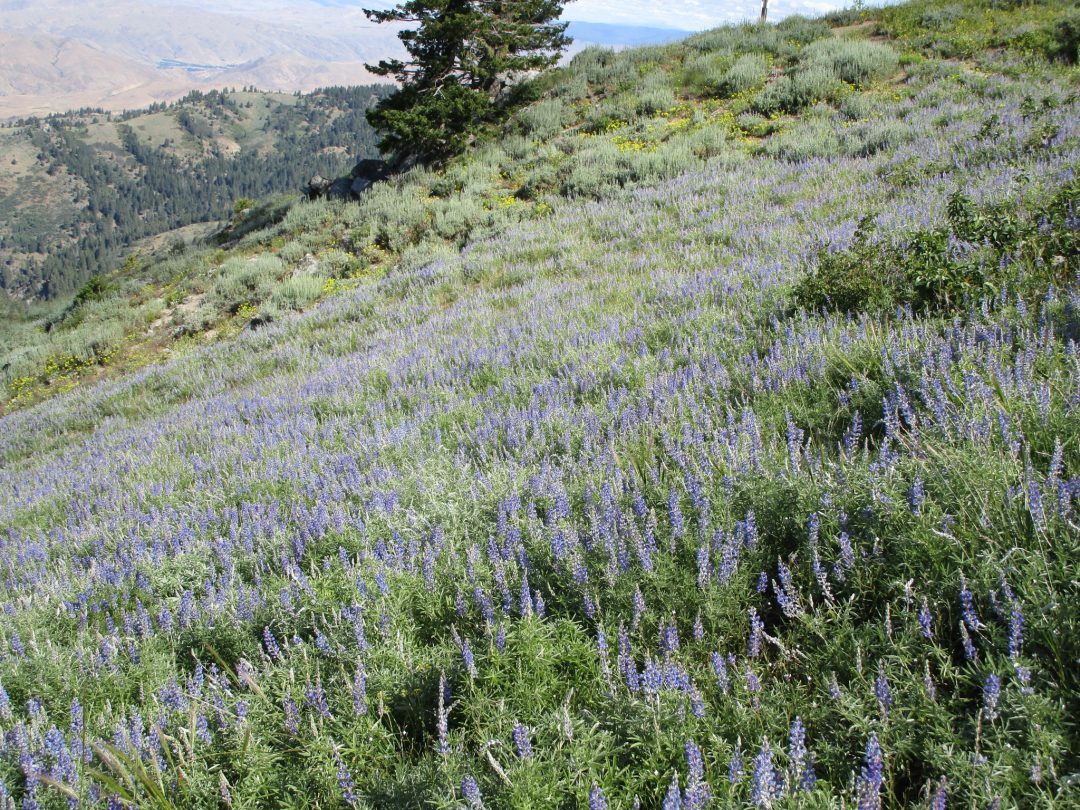
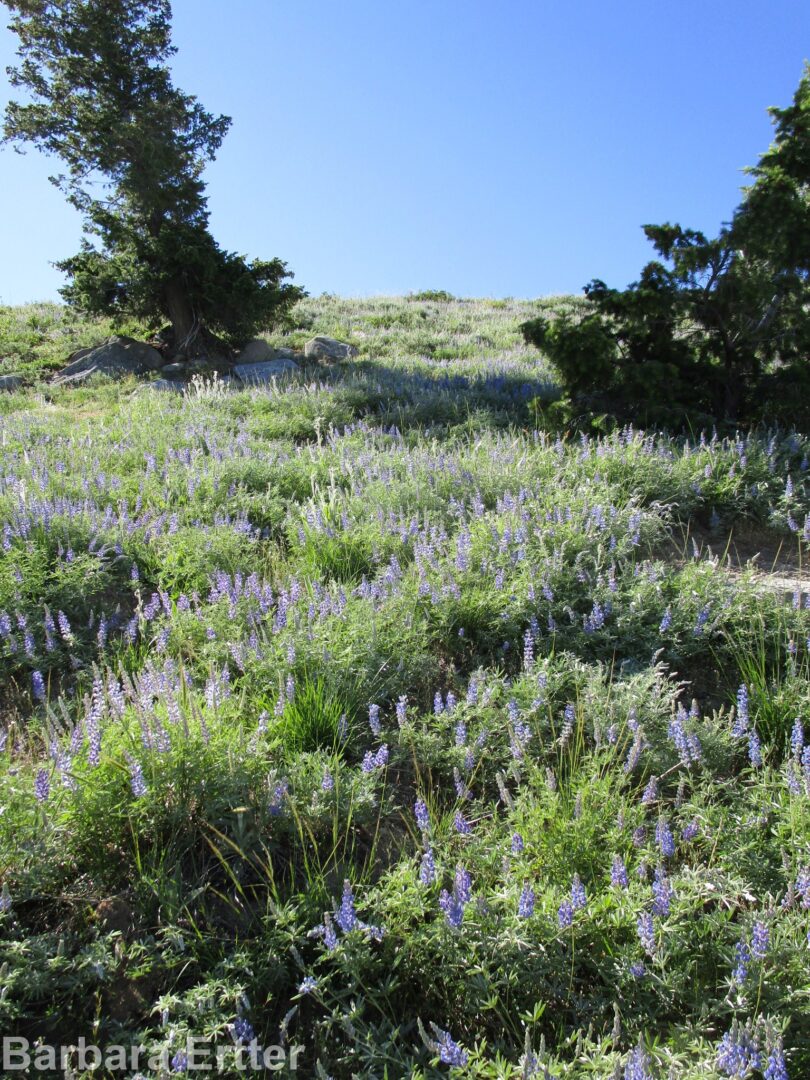
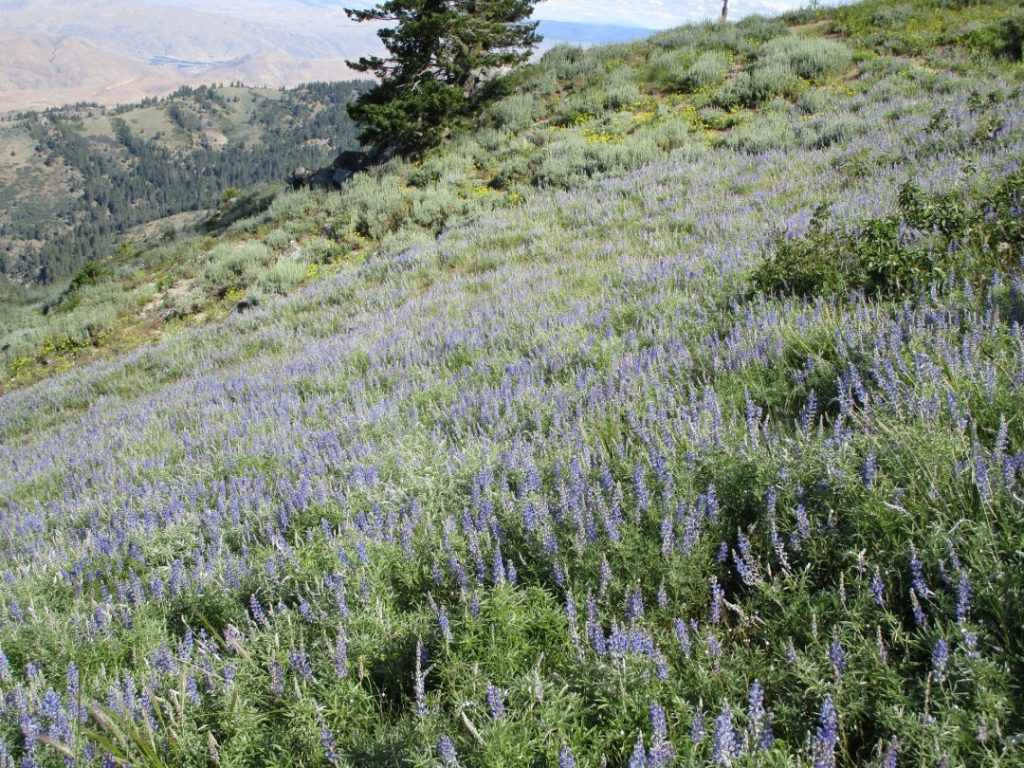
 Subalpine slopes on Mores Mountain and Shafer Butte are often densely covered by this small-flowered representative of the silver lupine complex, especially where snowbanks persist late in the season. In some sites, the plants are co-dominant with mountain big sagebrush (Artemisia tridentata ssp. vaseyana). One might think that such an abundant and relatively distinctive lupine should be easily associated with one of the names currently in use, but that turns out not to be the case (as is too often true for many other populations in this exceptionally complex and perplexing genus).
The silvery leaves, relatively short inflorescences, small flowers (7–8 mm), short-bulged calyx (< 1 mm), hairy banner back (at least below the calyx), and minimal gap between banner and wings at full anthesis make this key to L. holosericeus in Vascular Plants of the Pacific Northwest (Hitchcock et al. 1961). This was converted into L. argenteus var. holosericeus by Barneby (1989), in “an attempt to apply to Lupinus in our region standards of specific and subordinate rank comparable to other genera of Fabaceae”. The recent treatment of Lupinus for Flora of North America (Sholars & Riggins 2023) largely follows Barneby, at least for perennial species. However, Plants of the World Online, and hence iNaturalist, persist in using L. holosericeus (at least as of 30 July 2026).
Although the description is a reasonable fit for the subalpine lupine on the Boise Ridge, the habitat is more problematic. The treatment of L. holosericeus in Hitchcock et al. (1961) is reasonably compatible, albeit vague: “Pine woodlands and sagebrush slopes” in the mountains of south-central Idaho and adjacent Oregon. Barneby (1989), however, indicates that the variety is primarily known on “sagebrush plains and low hills”, mostly below 1900 meters (about 6230 feet) elevation; in contrast, our plants from the Boise Ridge are mostly above 2000 meters. Barneby might have been focusing only on those plants occurring in the Intermountain Flora (i.e., Snake River Plains and south), since he expanded the distribution to include northern Nevada and possibly Colorado while at the same time omitting any mention of central Idaho. This distribution is largely repeated by Sholars and Riggins (2023), with the addition of northeastern Utah. As a further twist, the name L. holosericea is based on a collection by Thomas Nuttall in 1840, purportedly from “islands and gravelly banks” of the Willamette River in western Oregon. This is generally considered a mistaken locality, however, with the type specimen more likely collected during Nuttall’s trek across southwestern Idaho (e.g., Hitchcock et al. 1961, Barneby 1989).
Alternatively, these plants might be a better fit for L. argenteus var. utahensis, which is what Don Mansfield (pers. comm. 2026) is calling similar populations from the Owyhee Mountains. According to Flora of North America, “[var. holosericeus] is close to var. utahensis, but the flowers are smaller, and the calyx is not spurred”, and the elevation range of var. utahensis encompasses subalpine, and even alpine, habitats. It boils down to how small is “smaller”, and what the break is between a calyx spur vs. a mere bulge, with our subalpine plants spanning the numerical dividing lines. Without ready access to authoritatively identified comparative specimens, it comes down to a flip of the coin.
Another possibility is L. argenteus var. depressus, at least as defined in Hitchcock et al. (1961), though the original description indicates that the banner is glabrous. Furthermore, Barneby (1989) re-interpreted this variety as “a dwarfed aspect” of var. rubricaulis when it ascends to or above timberline; this synonymy was also adopted for Flora of North America. Given that our subalpine plants lack key diagnostic characters of var. rubricaulis (i.e., leaflets green on upper surface, larger flowers), var. depressus/rubricaulis is not a satisfactory option, either.
If a name beyond those currently in use ends up being justified, earlier treatments provide a plethora of options to choose from. According to Hitchcock et al., “Taxonomically, the genus is probably in a more chaotic state than any other to be found in our area, nearly 600 taxa having been described for the U.S.” The vast majority of these validly published names are currently treated as taxonomic synonyms of a much smaller number in active use, but the are all available for “resurrection” (yes, that is a word that taxonomists use!) if deemed appropriate. Whether our subalpine plants match any of them would take significant work to determine, well beyond the scope of this synopsis.
In the meantime, I’m more inclined to go provisionally with var. holosericeus rather than var. utahensis, given the smaller flowers and spur/bulge less than 1 mm. Given the altitudinal disjunction from other populations of either var. holosericeus or var. utahensis, however, my suspicion is that future research may reveal that these subalpine populations deserve their own name. I furthermore suggest “Snowbank lupine” as a common name specific for whatever we actually have, and encourage seeking out the stunning displays it puts on in the middle of summer for those willing to hike to where it grows. Enjoy!
Barneby. R. C. 1989. Fabales. Intermountain Flora, vol. 3, part B.
Hitchcock, C. L., A. Cronquist, M. Ownbey, and J. W. Thompson. 1961. Vascular Plants of the Pacific Northwest, part 3: Saxifragaceae to Ericaceae. University of Washington Press.
Sholars, T. and R. Riggins. 2023. Lupinus. Flora of North America north of Mexico 11.1: 193–249.